

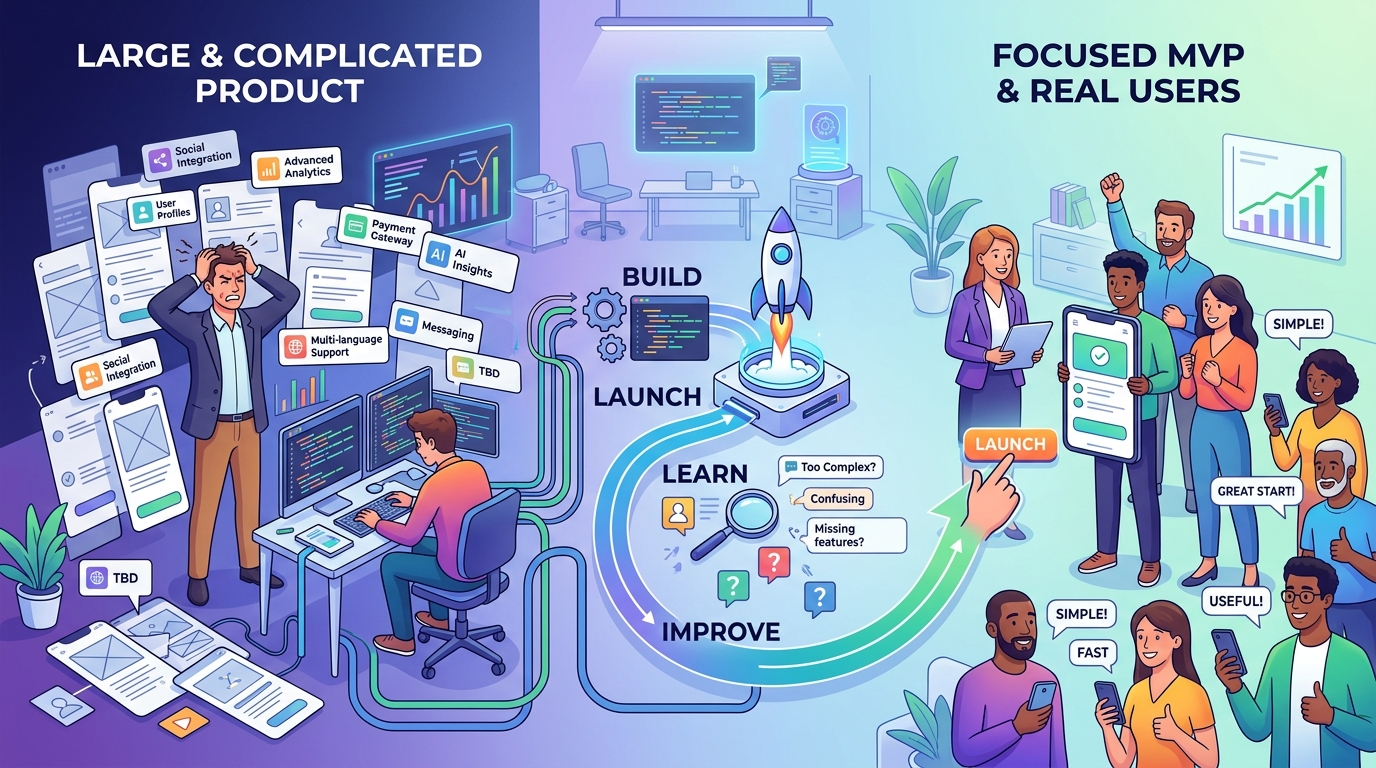
Why MVP Development Is Better Than Building Everything
Having a great app idea is exciting.
You start imagining everything the product could eventually do.
User profiles.
Chat.
Payments.
AI.
Analytics.
Subscriptions.
Notifications.
Advanced dashboards.
Social features.
Integrations.
Before you know it, a simple app idea has turned into a massive development project.
This is where many startups make a costly mistake.
They try to build the complete product before learning whether users actually want it.
A better approach is often to start with an MVP — Minimum Viable Product.
An MVP allows you to build the essential version of your product, launch it to real users, learn from their behavior, and then improve it based on evidence.
What Is an MVP?
An MVP is the simplest useful version of a product that solves its core problem.
It doesn't mean building something broken or low quality.
It means focusing on the features that are actually necessary to deliver the main value.
For example, imagine you want to build a food delivery application.
You could eventually build:
- Customer app
- Restaurant app
- Driver app
- Advanced analytics
- Loyalty system
- AI recommendations
- Subscription plans
- Multiple payment methods
- Real-time tracking
- Promotional system
- Referral program
That's a large product.
But an MVP might focus on:
- Customer registration
- Restaurant listings
- Food ordering
- Basic payment
- Order status
- Basic restaurant management
The goal is to test the core concept first.
Why Building Everything Is Risky
Building a large application requires significant time and resources.
If you spend months developing dozens of features before getting real customer feedback, you are making many assumptions.
You are assuming:
- Users want those features.
- Users understand the product.
- Users will return.
- Users will pay.
- Your workflow is correct.
- Your pricing is right.
- Your design is intuitive.
Some of those assumptions may be wrong.
The longer you develop before testing, the more expensive those mistakes can become.
1. Launch Faster
One of the biggest advantages of an MVP is speed.
Instead of spending a long time building every possible feature, you focus on the core experience.
This allows you to get the product into the hands of real users sooner.
For a startup, speed matters because the market can change quickly.
A competitor can launch.
Customer expectations can change.
Technology can evolve.
Your original idea may even change after talking to users.
Launching earlier gives you the opportunity to learn earlier.
2. Reduce Initial Development Costs
Every additional feature requires development, testing, design, maintenance, and sometimes infrastructure.
If you build 40 features instead of 10, the project becomes significantly more complex.
An MVP reduces the initial scope.
For example:
Full Product
40+ features
Large development team
Long development timeline
Higher initial investment
Compared with:
MVP
Core features
Focused development
Shorter timeline
Lower initial investment
This doesn't mean the final product will always cost less.
It means you're reducing the amount of money you risk before validating the idea.
3. Test the Market
This is one of the most important reasons to build an MVP.
You can ask people whether they like your idea.
But what people say and what they actually do can be very different.
An MVP gives you real-world evidence.
You can see:
- Are users signing up?
- Are they using the core feature?
- Are they returning?
- Where do they stop?
- What features do they request?
- Are they willing to pay?
This information is much more valuable than assumptions.
4. Get Real User Feedback
Your development team may believe a feature is useful.
Your customers may disagree.
Users interact with products differently than developers expect.
For example, you might create five steps for completing an action.
After launch, users may consistently struggle with step three.
Now you know where the experience needs improvement.
Real users can help you discover problems that internal testing doesn't always reveal.
5. Discover Which Features Actually Matter
A common problem with software development is feature overload.
Businesses often create a long feature list based on assumptions.
After launch, they discover that users primarily use two or three features.
Other features receive almost no attention.
An MVP helps you identify what actually matters.
Suppose your app has:
10 core features.
After three months, analytics show that users heavily use only four.
Those four features may deserve more investment.
The other six might need improvement, redesign, or removal.
6. Reduce the Risk of Building the Wrong Product
Imagine spending six months building an application.
You launch it.
Users don't understand the value.
Or they don't have the problem you thought they had.
Or they prefer another solution.
You now have a significant investment in a product that needs major changes.
An MVP reduces this risk by testing the core idea earlier.
You're still taking a risk.
But you're taking a smaller and more manageable risk.
7. Improve the Product Using Real Data
An MVP isn't only about launching quickly.
It's about learning.
After launch, you can collect useful information such as:
- User registrations
- Feature usage
- Retention
- Conversion
- Session behavior
- User feedback
- Crash reports
- Support requests
This data can influence your next development decisions.
Instead of saying:
"I think users need this feature."
you can eventually say:
"Our users are repeatedly asking for this feature and the data supports it."
That's a much stronger foundation for product development.
8. Make Better Investment Decisions
Imagine your MVP attracts users and demonstrates strong demand.
Now you have evidence that the concept has potential.
You can make a more informed decision about investing in:
- Advanced features
- Marketing
- Infrastructure
- Additional developers
- New platforms
- Integrations
- Customer support
Instead of making a large investment based entirely on an idea, you can use actual product performance to guide your next steps.
9. Make Changes Before the Product Becomes Too Complex
Changing a product early is generally easier than changing a large system later.
Imagine your application has:
10 features.
Changing the user flow may be relatively manageable.
Now imagine the same application has:
80 features
Multiple user roles
Complex integrations
Thousands of users
Changing the same workflow may affect many parts of the system.
An MVP gives you the opportunity to validate important decisions while the product is still relatively focused.
MVP Doesn't Mean Poor Quality
This is an important misunderstanding.
Some people think MVP means:
"Build a cheap app with bugs."
That's not the goal.
An MVP should still provide a good experience.
It should be:
- Stable
- Usable
- Secure
- Professionally designed
- Focused
- Capable of solving the core problem
The difference is scope, not quality.
You're building fewer features, but the features you do build should work properly.
What Should Be Included in an MVP?
There is no universal MVP feature list.
It depends entirely on the product.
A good MVP should include features that are necessary to deliver the core value.
For example, a service booking application might need:
User Side
- Registration
- Service browsing
- Booking
- Booking history
- Notifications
Business Side
- Service management
- Booking management
- Customer information
Admin Side
- User management
- Business management
- Basic reporting
Everything else can potentially come later.
What Should Usually Come Later?
Advanced features can be added after validation.
For example:
- AI recommendations
- Advanced analytics
- Loyalty programs
- Complex referral systems
- Multiple subscription plans
- Advanced personalization
- Complex automation
- Additional integrations
These features may become valuable.
But you should ideally have evidence that they are worth building.
MVP Development Process
A practical MVP development process can look like this:
Step 1: Define the Problem
Clearly identify the problem you're solving.
Step 2: Identify the Target User
Understand who experiences the problem.
Step 3: Research Competitors
Understand existing solutions and market gaps.
Step 4: Define the Core Value
Determine what your product must do to solve the problem.
Step 5: Prioritize Features
Separate essential features from future ideas.
Step 6: Design the MVP
Create user flows and UI/UX designs.
Step 7: Develop
Build the mobile app, backend, APIs, database, and required integrations.
Step 8: Test
Test functionality, usability, performance, and security.
Step 9: Launch
Release the MVP to a controlled group or the wider market.
Step 10: Measure
Track user behavior and feedback.
Step 11: Improve
Use what you learned to determine the next features.
Example: A Marketplace App
Imagine you have an idea for a marketplace connecting buyers and sellers.
The full product could include:
- Buyer accounts
- Seller accounts
- Product listings
- Search
- Filters
- Chat
- Reviews
- Payments
- Delivery tracking
- AI recommendations
- Seller analytics
- Promotions
- Loyalty
- Referral system
- Subscription plans
Building everything at once would require significant time and resources.
An MVP could start with:
Buyer Registration
Seller Registration
Product Listings
Search
Product Details
Basic Messaging
Basic Transaction Flow
Now you can launch.
After real users start using the marketplace, you can determine which features deserve priority.
Build, Launch, Learn, Improve
The MVP philosophy can be summarized in four words:
Build
Create the smallest useful product.
Launch
Put it in front of real users.
Learn
Understand what users actually need.
Improve
Build the next version based on evidence.
Then repeat the process.
This creates a continuous product development cycle.
When an MVP May Not Be the Best Approach
MVP development is powerful, but it isn't appropriate for every situation.
Some products require significant functionality before they can provide value.
For example, a complex financial, medical, industrial, or enterprise system may require more extensive planning, security, compliance, and infrastructure before launch.
In these cases, reducing the scope too aggressively can create problems.
The goal isn't to make every project as small as possible.
The goal is to find the smallest realistic version that can safely and meaningfully validate the product.
MVP vs Full Product
| MVP | Full Product |
|---|---|
| Focused feature set | Broad feature set |
| Faster initial launch | Longer development |
| Lower initial investment | Higher initial investment |
| Designed for validation | Designed for scale |
| Real user feedback early | More features before feedback |
| Easier to change | More complex to change |
| Focuses on core problem | Covers broader requirements |
Neither approach is automatically better.
The MVP approach is about reducing unnecessary risk before making larger investments.
Common MVP Mistakes
Trying to Include Everything
If your MVP has 50 features, you may have simply built the full product under a different name.
Ignoring Design
MVP doesn't mean users should receive a confusing interface.
Launching With Major Bugs
A small feature set still needs proper testing.
Not Collecting Feedback
Launching without measuring user behavior wastes one of the biggest advantages of an MVP.
Adding Features Without Evidence
Don't automatically add every feature users request.
Prioritize based on business goals, user demand, and data.
Final Thoughts
Building a complete product from day one can feel exciting.
You can imagine every feature and every possibility.
But building everything before validating the core idea can create unnecessary cost, complexity, and risk.
An MVP gives you a different path.
Start focused.
Launch sooner.
Learn from real users.
Improve based on evidence.
The goal isn't to build less forever.
The goal is to build the right things in the right order.
A successful product doesn't need every feature on day one.
It needs to solve one important problem well.
Frequently Asked Questions
What does MVP mean?
MVP stands for Minimum Viable Product. It is a focused version of a product containing the essential functionality needed to solve its core problem and validate the idea with real users.
Is an MVP a low-quality product?
No. An MVP should still be stable, usable, secure, and professionally designed. The difference is that it has a smaller feature scope.
How long does it take to build an MVP?
It depends on the product's complexity. A focused application with a small number of features can be developed much faster than a platform with multiple user roles, payments, chat, and complex integrations.
Should an MVP have a backend?
If the product requires accounts, data storage, authentication, payments, messaging, or other server-side functionality, then a backend will usually be required.
Can an MVP become a full product?
Yes. Many products start with a focused MVP and evolve through multiple versions as user feedback and business requirements become clearer.
Blog CTA
Don't spend months building features that nobody asked for.
At GoTech Studio, we help startups and businesses define their MVP, prioritize the right features, design the user experience, and build the technology needed to get the first version into real users' hands.
From MVP strategy to UI/UX, mobile development, backend APIs, testing, and launch, we can help you build a focused product with a clear path for growth.
Have an app idea? Let's define your MVP and build what matters first.