

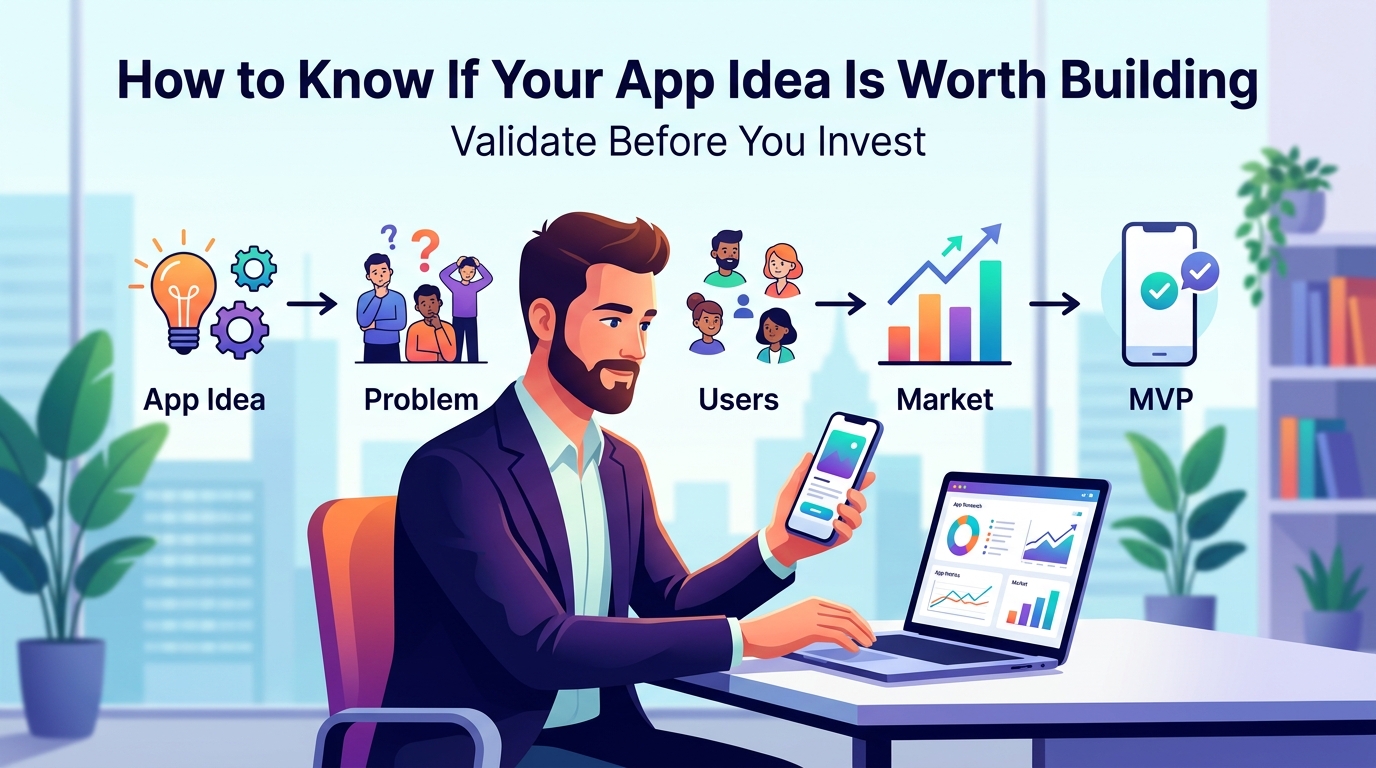
How to Know If Your App Idea Is Worth Building
Almost every successful application starts with an idea.
Someone notices a problem.
Someone imagines a better way to do something.
Someone thinks:
"There should be an app for this."
But having an idea doesn't automatically mean you have a successful business.
The biggest mistake is starting development immediately without understanding whether people actually need the product.
Building a mobile application can require significant time, money, design work, development, testing, marketing, and maintenance.
That's why validating your idea before development can reduce unnecessary risk.
The goal isn't to guarantee success.
No validation process can do that.
The goal is to gather enough evidence to make a better decision.
1. Start With the Problem
Don't start with:
"I want to build an app."
Start with:
"What problem am I solving?"
This is one of the most important questions you can ask.
For example:
Bad starting point:
"I want to build a food app."
Better:
"People in my target area have difficulty finding reliable home-cooked meals from local sellers."
Now you have a specific problem.
The clearer the problem, the easier it becomes to understand your potential users and product.
2. Identify Your Target Users
You can't build an app for "everyone."
You need to understand who the product is actually for.
Ask:
- Who experiences this problem?
- How old are they?
- Where are they located?
- What do they currently use?
- How frequently do they experience the problem?
- What motivates them to find a solution?
For example, instead of saying:
"My app is for businesses."
You might define:
"My app is for small restaurants that need a simple system for managing online orders."
A specific audience gives you a much clearer starting point.
3. Find Out How People Solve the Problem Today
Your potential users are probably already doing something to solve the problem.
They might use:
- Facebook groups
- Spreadsheets
- Websites
- Phone calls
- Existing applications
- Manual processes
This is valuable information.
If people are already spending time or money solving the problem, it may indicate that the problem is real.
Your job is to understand:
What is frustrating about the current solution?
That's where your opportunity may exist.
4. Research Your Competitors
Don't be afraid of competitors.
Competition can actually be a positive signal.
If other companies are already solving a similar problem, it may indicate that there is a market.
Study what they offer.
Look at:
- Features
- Pricing
- Reviews
- User complaints
- Ratings
- App store feedback
- Website experience
- Customer support
- Marketing
Don't only ask:
"How can I copy them?"
Ask:
"What are users still unhappy about?"
Those complaints can reveal opportunities.
5. Read Customer Reviews
One of the easiest ways to learn about a market is to read reviews of existing products.
Look for recurring complaints.
For example:
"The app is too complicated."
"Customer support never responds."
"There aren't enough payment options."
"The search doesn't work properly."
"I can't track my order."
If the same complaint appears repeatedly, pay attention.
A competitor's weaknesses can help you understand what potential users want improved.
6. Talk to Potential Users
Don't rely only on your own assumptions.
Talk to people who could potentially use your application.
Ask questions like:
How do you currently solve this problem?
What is the most frustrating part?
How often do you experience it?
Have you ever paid for a solution?
What would make you switch to another solution?
The goal isn't to convince people that your idea is great.
The goal is to listen.
7. Don't Ask Only "Would You Use It?"
This question can produce misleading answers.
Imagine asking someone:
"Would you use an app that makes this easier?"
They may say:
"Yes, sounds useful."
But that doesn't mean they will actually download it.
A better approach is to ask about their existing behavior.
For example:
"How do you currently solve this problem?"
"When was the last time you experienced it?"
"How much time or money did it cost you?"
Actual behavior is often more useful than hypothetical opinions.
8. Check Whether the Problem Is Frequent
A problem that happens once every five years may not justify a dedicated application.
Compare that with a problem users experience every day.
For example:
A daily productivity problem can create repeated engagement.
A weekly business problem can justify a subscription.
A frequent inconvenience can provide a stronger reason to return to an app.
Ask:
How often does this problem occur?
The answer can influence the product model.
9. Determine How Painful the Problem Is
Not every problem is worth solving with a new product.
Some problems are minor.
Others cost people:
- Time
- Money
- Productivity
- Customers
- Opportunities
- Convenience
The more significant the problem, the stronger the motivation to find a solution.
A useful question is:
"What happens if the user doesn't solve this problem?"
If the answer is:
"Nothing important."
you may need a stronger value proposition.
10. Define Your Unique Value
Why would someone choose your application instead of an existing solution?
Your answer shouldn't simply be:
"Our app has more features."
More features don't automatically create more value.
Your advantage could be:
- Easier workflow
- Lower cost
- Faster service
- Better customer experience
- Local focus
- Better specialization
- Improved automation
- Better integration
- More reliable service
Try to complete this sentence:
"Our app helps [specific users] solve [specific problem] by [unique approach]."
If you can't explain the value simply, the idea may need more refinement.
11. Define the MVP
You don't need to build everything.
Start with an MVP — Minimum Viable Product.
An MVP contains the smallest set of features needed to test the core idea.
For example, imagine you're building a local services marketplace.
Your first version might need:
- User registration
- Service listings
- Search
- Service details
- Booking
- Basic messaging
You might not need:
- Complex loyalty programs
- Advanced analytics
- AI recommendations
- Multiple subscription levels
- Dozens of notification types
Those features can come later.
12. Separate Must-Have Features From Nice-to-Have Features
Create two lists.
Must Have
Features required for the product to solve the core problem.
Nice to Have
Features that improve the experience but aren't necessary for the initial version.
This simple exercise can significantly reduce unnecessary development.
13. Build a Prototype Before the Full App
Before writing thousands of lines of code, consider creating a prototype.
A prototype can show:
- Main screens
- User flow
- Navigation
- Core functionality
- Product concept
You can show the prototype to potential users and collect feedback.
This is much cheaper than discovering major UX problems after development.
14. Test the Landing Page
Another simple validation method is creating a landing page.
Explain:
The Problem
Your Solution
Who It's For
Main Benefits
Then provide an action such as:
Join the Waitlist
or
Get Early Access
The number and quality of responses can provide useful signals about interest.
It isn't definitive proof of product-market fit, but it can help test messaging and demand.
15. Consider a Pre-Launch List
If people are genuinely interested, invite them to join a waiting list.
Collect information such as:
- Name
- Basic user type
- Problem they're trying to solve
Later, you can use this audience for beta testing.
A waiting list can also help you avoid launching to an empty market.
16. Think About Monetization Early
You don't necessarily need a complete pricing model on day one.
But you should understand how the business could eventually make money.
Possible models include:
Subscription
Users pay monthly or annually.
Commission
The platform takes a percentage from transactions.
Advertising
Businesses pay to reach users.
Freemium
Basic functionality is free while advanced features require payment.
One-Time Purchase
Users pay once for access.
Business SaaS
Businesses pay for using the platform.
The right model depends on your product and users.
17. Ask Who Will Pay
This is especially important for marketplace and B2B applications.
The person using the application may not be the person paying.
For example:
User: Customer
Payer: Business
Or:
User: Employee
Payer: Company
You need to understand the relationship between the user and the buyer.
18. Estimate Development Cost
Before committing to development, estimate what the first version will actually require.
Consider:
- UI/UX design
- Mobile development
- Backend development
- Database
- APIs
- Admin panel
- Cloud infrastructure
- Third-party services
- Testing
- App store publishing
- Maintenance
A simple MVP might be very different in cost from a full-featured platform.
That's another reason to define the MVP first.
19. Consider the Business Beyond the App
An app isn't a business by itself.
You may also need:
- Marketing
- Customer support
- Sales
- Operations
- Partnerships
- Content
- Customer acquisition
- Legal compliance
- Ongoing maintenance
A technically excellent application can still fail if nobody knows about it.
Think about the complete business model.
20. Look for a Real Distribution Strategy
Ask:
How will users discover my application?
Possible channels include:
- Social media
- Search engines
- Paid advertising
- Influencers
- Partnerships
- Communities
- Referral programs
- Existing customer base
- Direct sales
If your answer is:
"I'll upload it to the App Store and people will find it."
that's usually not enough.
Distribution should be part of the plan.
21. Calculate the Cost of Acquiring Users
You don't need perfect numbers initially.
But you should think about how much it might cost to acquire a customer.
Suppose you spend $1,000 on marketing.
If you acquire 100 paying customers, your acquisition cost is different from acquiring only 10.
Compare that cost with the value of each customer.
This becomes especially important for paid products.
22. Look for Strong Signals
Some signals can indicate that your idea deserves further testing.
For example:
People already spend money solving the problem.
Users repeatedly complain about existing solutions.
People actively search for solutions.
Potential users agree to test your product.
People join your waiting list.
Businesses are willing to discuss partnerships.
Potential customers are willing to pay.
These signals are more useful than simply hearing:
"That's a cool idea."
23. Watch Out for Warning Signs
Some signs suggest you should rethink or refine the idea.
Nobody Has the Problem
If users don't recognize the problem, adoption may be difficult.
Existing Solutions Are Already Excellent
You need a strong reason for users to switch.
The Audience Is Too Small
A niche can be valuable, but you need to understand its economics.
Users Don't Want to Pay
This doesn't always mean the idea is bad, but the business model may need to change.
The Product Requires Too Much Education
If users need significant explanation before understanding the value, your positioning may need improvement.
You Need Too Many Features Before Launch
This can make the project expensive and slow.
24. Don't Build for Yourself Alone
It's common for founders to think:
"I would use this app."
That's a useful starting point.
But you aren't the entire market.
Your personal preference doesn't guarantee market demand.
Validate the problem with other potential users.
25. Build a Small Test Version
Instead of asking:
"Should I spend a year building this?"
ask:
"What is the smallest version I can build to test the core assumption?"
This changes the development strategy.
You might discover that:
- Users love the idea
- Users don't understand the concept
- One feature is more valuable than expected
- Another feature isn't needed
- Pricing is wrong
- Your target audience is different
Learning these things early can save significant time and money.
A Simple App Validation Framework
Before building, answer these questions:
Problem
What specific problem are you solving?
Audience
Who experiences this problem?
Existing Solution
How do they solve it today?
Demand
How frequently does the problem occur?
Competition
Who already provides a solution?
Differentiation
Why would users choose you?
MVP
What is the smallest useful version?
Monetization
Who pays and why?
Distribution
How will users discover the product?
Validation
What evidence do you have that people want it?
If you can answer these questions clearly, you have a much stronger foundation.
Example
Imagine someone has an idea:
"I want to build an app connecting local businesses with freelance designers."
Before development, they should investigate:
Problem: Are businesses actually struggling to find designers?
Users: Small businesses and freelance designers.
Existing Solution: LinkedIn, freelance platforms, agencies, social media.
Differentiation: What will make this platform better?
MVP: Profiles, project posting, applications, messaging.
Monetization: Subscription, commission, or business listing fees.
Distribution: Local business communities, social media, partnerships.
Now the idea can be tested before building the full platform.
When Should You Start Development?
You don't need every answer before writing a single line of code.
But you should have enough evidence to understand:
Who you're building for.
What problem you're solving.
Why the problem matters.
How your solution is different.
What the MVP needs to accomplish.
How you plan to reach users.
Once those foundations are reasonably clear, development becomes much more focused.
The Goal Isn't Perfect Validation
No amount of research can guarantee that an application will become successful.
Markets change.
Competitors change.
Customer behavior changes.
New technologies appear.
The purpose of validation is not to eliminate all risk.
It's to reduce avoidable risk.
Instead of spending months building something nobody wants, you can test assumptions earlier.
Final Thoughts
A great app idea isn't just an interesting concept.
It solves a real problem for a specific group of people.
Before investing heavily in development, take the time to validate:
The problem
The users
The competition
The demand
The business model
The MVP
The distribution strategy
You don't need to build the entire product to learn whether people want it.
Start small.
Talk to users.
Test assumptions.
Build an MVP.
Measure the response.
Then improve.
Don't spend months building an app and only then ask whether people want it.
Validate the idea first, then build with confidence.
Frequently Asked Questions
How do I know if my app idea is good?
A strong app idea generally solves a meaningful problem for a specific audience and has evidence that users want a better solution.
Should I build an MVP first?
For many startup ideas, an MVP is a practical way to test the core product without investing in every possible feature.
How can I validate an app idea without coding?
You can conduct interviews, research competitors, create prototypes, build landing pages, collect waitlist signups, and test your value proposition.
Is competition a bad sign?
Not necessarily. Competition can indicate that a market exists. The important question is how your product will provide meaningful value compared with existing solutions.
Should I ask people if they would use my app?
You can, but questions about actual behavior are often more useful. Ask how they currently solve the problem and what they have already tried.
How many features should an MVP have?
Only enough features to solve the core problem and test your main assumptions. The exact number depends on the product.
When should I hire developers?
Ideally, after you have a reasonably clear problem, target audience, core value proposition, and MVP scope. This helps avoid spending development resources on unvalidated features.
Blog CTA
Have an App Idea?
Don't jump straight into development.
GoTech Studio can help you turn an early idea into a clear product plan, MVP, UI/UX design, and production-ready mobile application.
From idea validation and UI/UX to Flutter, Native Android, backend APIs, databases, and deployment, we can help you build the product step by step.
Have an idea? Let's validate it, plan it, and build it.